
Earning the download is only part of the job. In the earlier parts of our New Rules of App Growth series we looked at why discovery no longer belongs to any single channel and what it takes for consumers to feel confident enough to download and pay. This final part asks what happens once someone has your app on their phone: what keeps them coming back and using it?
Our research with Opinium, among 4,000 app users in the UK and US, gives a clear answer. People keep apps that are useful. They rarely keep them because they are new.
Download The New Rules of App Growth
Usefulness matters more than novelty
We asked consumers why they continue to use an app over time, and they could choose as many reasons as applied. The leading answers are about utility and fit:
- 38% say the app saves them time
- 36% say it makes something easier or more convenient
- 36% say it is enjoyable or entertaining
- 35% say it fits naturally into their routine
Novelty sits much further down. Just 18% cite new and fresh content, and 14% cite new products or features. Almost a quarter (24%) say they use an app without really thinking about it, which is arguably the clearest sign it has earned its place.
New features still matter, but mainly when they strengthen something people already rely on. They are unlikely to make up for an experience that lacks everyday usefulness.
In their own words, people describe outcomes, not features
We also asked people what makes an app feel “worth keeping” on their phone, in their own words. Of the 2,746 usable responses, almost 80% came down to two things: the app makes their life better (47.5%), or it fits naturally into their life (32.3%).
The features that often dominate product and marketing conversations barely appeared. Personalisation was mentioned in 0.3% of responses, and fresh content and unique functionality in 0.2% each. That does not make them unimportant. It suggests people describe the value an app gives them, not the features behind it.
For anyone buying or running acquisition, that has a practical consequence. The message that brings someone in should describe the outcome the app delivers, because that is the language people use when they decide to stay.
The UK and US describe value differently
Both markets expect apps to earn their place, but they put it differently. UK consumers lean towards utility and habit: 21.9% describe an app as useful or serving a purpose (against 10.4% in the US), and 23.6% mention regular or frequent use (against 17.8%).
US consumers lean towards overall value and enjoyment: 24.5% mention overall value (against 17.4% in the UK), and 9.4% mention enjoyment or fun (against 5.4%).
If you run campaigns in both markets, the same app may need a different emphasis in each.
Notifications are a value exchange
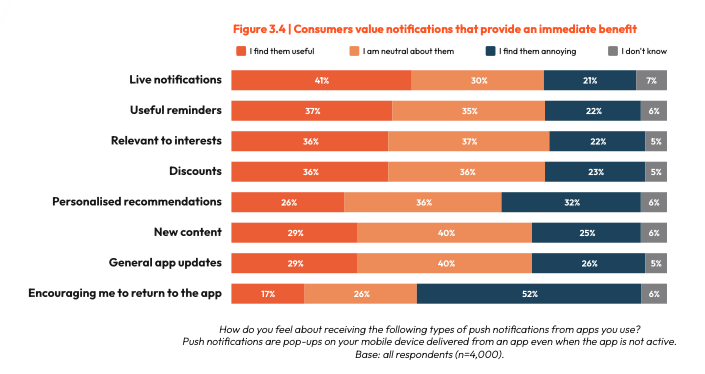
Attitudes to push notifications depend on what the person gets in return. More than half of consumers (52%) find notifications designed simply to bring them back to an app annoying, and only 17% find them useful.
The best received types all offer something specific. Live notifications lead, with 41% finding them useful, followed by useful reminders (37%), notifications relevant to their interests (36%) and discounts (36%). Personalised recommendations are found annoying by 32%, so knowing something about a user is not the same as giving them a reason to care at that moment.
The question to ask of every message is why it is useful to this person right now. If the only honest answer is “to get them to open the app”, it is likely to cost more goodwill than it earns.
Permission has to be earned too
Personal data belongs to the same exchange. Across the ten app categories we asked about, an average of 43% of consumers say they would not share any personal information with an app in return for a better experience. That ranges from 32% for Retail to 53% for Gaming.
Willingness depends on relevance. 38% would share their location with a Travel & Navigation app, compared with 10% for Gaming apps. Women are more cautious than men: on average 46% of women would share nothing, against 39% of men. We cover this in more detail in App permissions should be the outcome of trust, no the starting point, but the principle is the same as for notifications. The clearer the link between what you ask for and what the person gets, the stronger the case for saying yes.
Apps rarely lose users with a bang
It is natural to focus on the visible reasons people leave. They matter: 24% stopped using an app because of an expensive subscription, 24% because of too many ads, and 19% because of bugs, crashes or slow performance. 15% stopped because a subscription was added for something they used to get without paying.
But the most common reason is quieter. 32% say they stopped because they no longer needed the app, and a further 23% say they did not use it enough or forgot about it. An app can lose its place in someone’s life without ever delivering a particularly poor experience. Needs change, habits weaken and alternatives appear.
As Rishan Weerakoon, Strategic Growth Director at Yodel Mobile, puts it in the report: “The strongest retention strategy is not finding more reasons to bring consumers back. It is continuing to give them a reason to need you.”
Acquisition and retention are one job
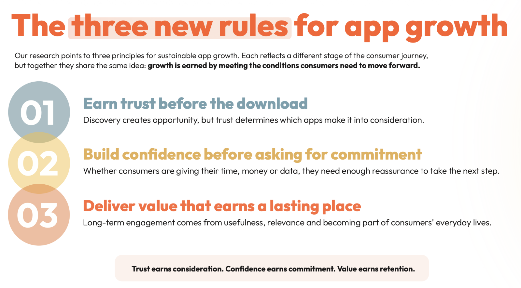
This is where the series comes together. The expectations you set in your ads and on your store listing shape how people judge the app once they are inside it. Rule 1 is to earn trust before the download. Rule 2 is to build confidence before asking for commitment. Rule 3 is to keep earning value after it. They describe one journey, and a weak link anywhere in it limits the rest.
It also changes what acquisition quality means. Attracting people with a proposition the product delivers on from the first session, and then keeps delivering on, is worth more than a lower cost per install that brings in people who never find a use for the app.
Download The New Rules of App Growth for the full findings on engagement, notifications, data sharing and churn, plus the UK and US splits behind each.