

Welcome to Part 1 of The New Rules of App Growth series, where each week we unpack a key finding from our research with Opinium and turn it into practical steps for app marketers.
We surveyed 4,000 app users across the UK and US, expecting to uncover new growth tactics. Instead, we found something more fundamental: the journey remains familiar, but consumers have become more deliberate at every stage.
The app economy has matured. Consumers have more choice than ever, more ways to discover apps and more reasons to be careful about what they commit to. App stores now sit alongside search, social, recommendations and AI tools, while subscriptions and data permissions ask more of every user.
To understand what this means for growth, we worked with Opinium to explore how consumers discover, choose and continue using apps across the UK and US. What came back was not a new funnel. Instead, we found a more deliberate consumer and three conditions that determine whether they move from one stage of the journey to the next.
Rule 1: Earn trust before the download
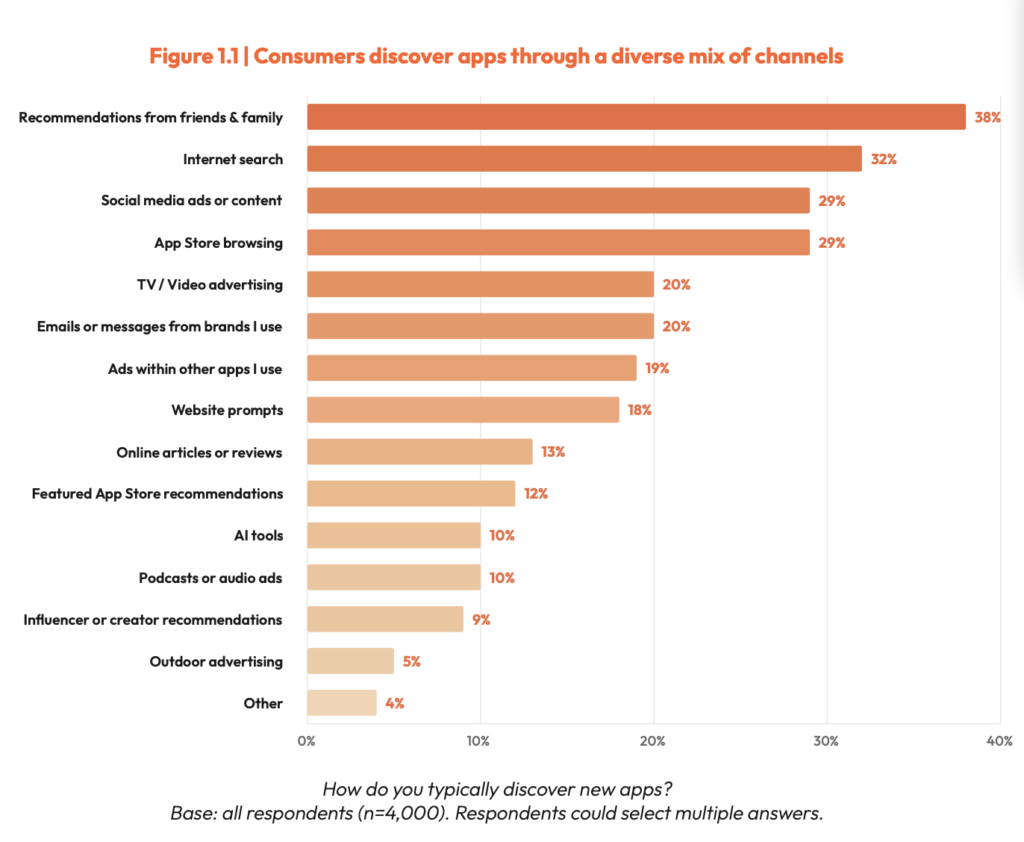
Discovery has fragmented. The most common route to a new app, recommendations from friends and family, is chosen by 38% of consumers, and no route is chosen by more than 40%. People find apps through search (32%), social media ads or content (29%), App Store browsing (29%) and a long tail of other channels.
Finding an app is not the same as trusting it. 84% say they trust recommendations from friends and family when choosing a new app, while fewer than half trust social media ads (48%), ads within other apps (45%) or AI tools (44%). The channels that generate discovery are not always the ones that reassure.
At the point of download, consumers look for proof. 90% say clear pricing and subscription information is important, 89% say the same of clear privacy and data information, and 83% of ratings and reviews. The store listing is where those signals come together.
Rule 2: Build confidence before asking for commitment
A download asks very little of a user. Paying, subscribing or sharing data asks much more. 28% of consumers say they would never pay for an app or subscription, and 76% say they would usually look for a free alternative rather than pay.

For those who are open to paying, reassurance beats discounting. Among people willing to pay, 30% say clear pricing with no hidden costs would give them confidence to pay for an app they have not used before. Only 15% say the same of promotional offers.
The same logic applies to data. Depending on the app category, between 32% and 53% of consumers would share no personal information at all. But relevance changes the answer: 38% would share their location with a travel app, compared with 10% for a gaming app.
Rule 3: Keep earning value after conversion
Conversion is not the end of the journey. It is where the promises made earlier start to be tested.

Consumers keep apps that are useful. 38% say they continue using an app because it saves them time, while only 14% point to new products or features. The most common reason for stopping is simply no longer needing the app (32%). In their own words, almost 80% of the responses we analysed described an app that makes life better or fits naturally into everyday life.
An app can work perfectly well and still lose its place if it stops being necessary.
From funnel to loop
Trust earns consideration. Confidence earns commitment. Value earns retention.
These are not separate stages. They build on one another, and each feeds the next. Reviews and recommendations from existing users become the trust signals that persuade new ones. That is why we think of app growth as a loop rather than a funnel, and why acquisition, conversion and retention cannot be optimised in isolation.
What growth teams should do next:
- Optimise for proof, not just presence. Make ratings, reviews and recommendations visible wherever your app is found, and treat the store listing as a place where trust is validated.
- Reduce uncertainty before you add friction. Show the value early, be clear about price and cancellation, and ask for permissions when the reason is obvious.
- Design for usefulness, not attention. Find the moments where your app delivers recurring value and build the experience around them.
The fundamentals of app growth have not gone away. What has changed are the conditions consumers need to keep moving through them.
Download The New Rules of App Growth to explore the complete findings from 4,000 app users, including how behaviour differs between the UK and US and what growth teams should do next.
About the research report
The research was conducted by Opinium on behalf of Yodel Mobile between 2 and 9 April 2026, among 4,000 adults aged 18+ who use an app at least once a week, 2,000 in the UK and 2,000 in the US.







5 minute read
A history of app marketing, as told by a founder who was there before day one
Mick Rigby