


Why organic and paid acquisition work better together in 2026
The mobile app industry continues to evolve at an incredible pace, and in 2026, developing a great product and launching it on the App Store or Google Play is no longer enough to guarantee success. With millions of apps competing for attention, the challenge is not simply generating installs. Instead, app marketers must attract high quality users, keep acquisition costs under control and drive long term engagement.
As user acquisition becomes increasingly competitive, marketers are navigating rising acquisition costs, evolving privacy regulation, and AI driven advertising platforms that increasingly reward quality over volume. At the same time, the line between organic and paid acquisition is becoming less distinct. The brands achieving sustainable growth are no longer treating organic and paid acquisition as separate strategies. Instead, they are combining them to create a more scalable, data-driven approach to mobile growth.
At the centre of this relationship is App Store Optimisation. ASO is not simply an organic acquisition channel. It acts as a discovery and conversion layer that can strengthen the performance of both organic and paid activity. This blog explores why integrating organic and paid acquisition has become one of the most effective mobile growth strategies in 2026.
What is the key difference between organic and paid acquisition?
Before exploring how the two strategies work together, it’s important to understand their different roles.
Organic acquisition refers to users discovering and downloading your app without directly clicking on paid advertising. This can include users finding your app through the App Store or Google Play search, browse and recommendation surfaces, as well as through existing brand awareness and other unpaid marketing activity.
Examples of organic acquisition include:
- App Store Optimisation (ASO)
- Organic social media content
- User generated content (UGC)
- Influencer and creator partnerships
- Email marketing
- Referral programmes
- Push notifications
- Word of mouth recommendations
Paid acquisition involves investing in advertising platforms to drive app installs and valuable in-app actions. Paid media enables marketers to reach new audiences, scale acquisition quickly and generate measurable performance data.
Popular paid acquisition channels include:
- Apple Search Ads
- Google App Campaigns
- Meta
- TikTok
- Snap
Organic acquisition can build long term visibility and sustainable discovery, while paid acquisition provides speed, scale and valuable performance insights. However, the strongest strategies do not treat these as separate channels. They recognise that each can directly influence the performance of the other.
Why combining organic and paid acquisition matters
Organic and paid acquisition are often measured separately, but the user journey rarely works that way. Paid campaigns can introduce new audiences to an app, increasing awareness and familiarity with the brand. Not every user who sees or clicks an advert installs immediately. Some may later search directly for the app, browse the App Store or Google Play, or encounter it again through recommendation surfaces. This means paid activity can create additional organic demand. As awareness increases, branded search volume may grow, creating more opportunities for users to discover the app organically. Strong App Store visibility can then help capture that demand.
This is where ASO becomes particularly important. A well optimised store presence does not just help an app rank for relevant search terms. It can improve visibility across search, browse and recommendation surfaces, while also improving the likelihood that users who reach the store will actually install. Strong screenshots, clear messaging, compelling metadata, positive ratings and reviews all contribute to the conversion experience. This means ASO can directly improve paid efficiency: if more users convert after arriving on the App Store or Google Play, more paid clicks turn into installs, helping improve campaign efficiency and potentially reducing effective acquisition costs.
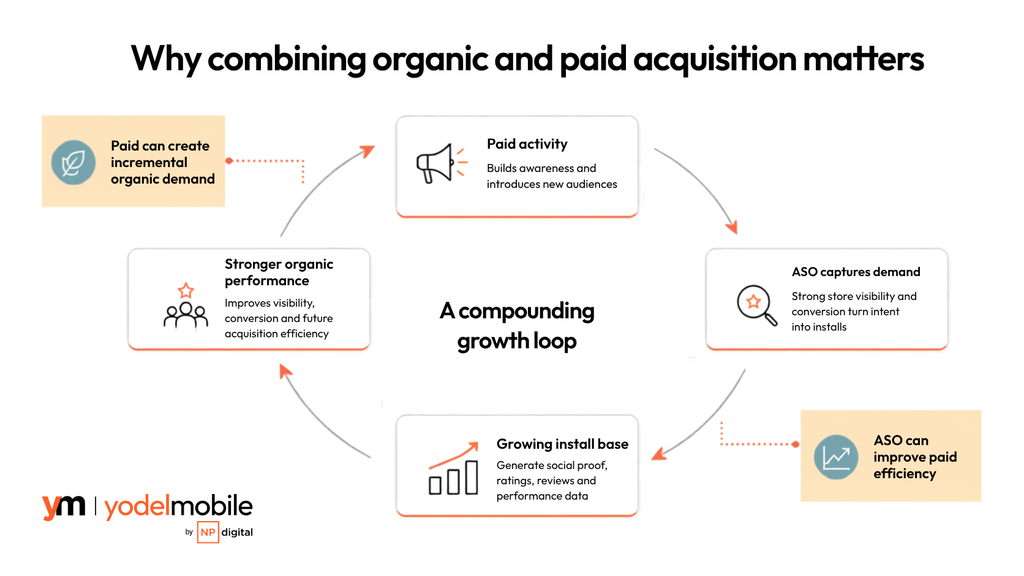
Rather than operating independently, paid acquisition, ASO and organic discovery can create a continuous feedback loop:
Paid activity creates awareness – ASO captures and converts demand → increased installs generate more social proof and data – stronger organic visibility and conversion improve future acquisition performance.
AI is changing both ASO and User Acquisition
The biggest shift in mobile user acquisition in recent years has been the rapid adoption of AI powered campaign optimisation. Platforms such as Google App Campaigns, Meta Advantage+, TikTok Smart Performance Campaigns and Apple Search Ads increasingly use machine learning to automate elements of bidding, audience targeting and creative delivery. These systems analyse large volumes of signals to identify users most likely to complete valuable actions within an app.
As a result, the role of the app marketer is evolving. Success is becoming less about manually controlling every audience or placement and more about providing the platform with the strongest possible inputs. High quality creative, meaningful conversion events, reliable measurement and continuous testing all play an important role in helping AI systems optimise effectively. The best performing campaigns combine automation with a strong testing strategy, continuously improving the creative assets, optimisation signals and measurement framework available to the platform.
ASO
AI is also beginning to change how users discover and evaluate apps. App discovery is increasingly moving beyond traditional keyword searches, with users able to use more conversational and specific queries to describe what they need. Rather than searching for a single keyword, users may increasingly describe a problem or outcome they want an app to help them achieve. This makes understanding search intent and clearly communicating an app’s value proposition even more important.
ASO therefore needs to focus not only on individual keywords, but on how clearly an app communicates what it does, who it is for and the needs it serves. Metadata, app descriptions, screenshots and store messaging should work together to communicate an app’s purpose and value, helping it remain relevant as discovery experiences evolve.
AI is also creating new opportunities within the ASO process itself. AI powered tools can help marketers analyse search trends, identify keyword opportunities and understand how users describe different app categories. At the same time, AI generated and AI assisted store listing content is likely to make the quality and clarity of the underlying app information increasingly important. Rather than simply producing more content, app marketers need to ensure that the information presented across the store accurately and consistently communicates the app’s key features and value.
Discoverability is also extending beyond the traditional app stores. As users increasingly rely on AI powered search engines and assistants to answer questions and recommend products, apps need to be discoverable and clearly understood within these wider search environments as well as within the App Store and Google Play.
Ratings and reviews may also play an increasingly important role in this process. As AI powered experiences make it easier to summarise large volumes of information, users may increasingly encounter AI generated summaries of an app’s reviews rather than reading individual reviews. This means overall review sentiment and the recurring themes within user feedback could become an even more important part of how potential users evaluate an app.
The fundamentals of ASO remain important: understanding user intent, communicating value clearly and creating a strong conversion experience. However, the definition of discoverability is expanding. ASO increasingly needs to consider how users search, how platforms interpret app information and how AI powered experiences surface and evaluate apps.
Looking beyond installs
In today’s privacy first ecosystem, installs are no longer always the most meaningful measure of acquisition success. An install confirms that a user has downloaded an app, but it does not necessarily indicate whether they will register, subscribe, make a purchase or become an engaged, long term user. Increasingly, effective user acquisition strategies focus on the quality of users being acquired and the meaningful actions they take after installing, such as creating an account, completing onboarding, starting a subscription or free trial, making a purchase, engaging with content or returning to the app over time.
Optimising paid campaigns towards these downstream events allows advertising platforms to identify and prioritise users who are more likely to deliver value beyond the initial install. The objective therefore shifts from simply maximising acquisition volume to driving higher quality users and more valuable outcomes. While ASO does not directly measure metrics such as ROAS or cost per subscription, it can play an important role earlier in the acquisition journey by improving relevant discovery and increasing store conversion. Understanding how each discipline contributes at different stages of the funnel, and how they work together to influence overall acquisition quality, is key to building a more effective and sustainable growth strategy.
How paid acquisition strengthens organic growth
One of the key advantages of paid acquisition is the volume of actionable insight it generates. Campaign performance can reveal which creative concepts, messages, audiences and search behaviours resonate most strongly with users. These learnings can then be applied across organic activity and ASO, creating a feedback loop between paid and organic growth.
For example:
- High performing paid messaging can inform App Store screenshots, metadata and store messaging.
- Winning creative concepts can be adapted for organic social and UGC.
- Paid search insights can identify new keyword opportunities for ASO and Apple Search Ads.
- Audience and engagement insights can inform influencer partnerships, UGC strategies and broader creative development.
Paid activity can also contribute to organic growth by increasing overall brand awareness and generating additional branded searches and organic installs that may not be directly attributed to the original campaign. This is particularly important when assessing the wider impact of paid acquisition. The influence of a paid campaign does not necessarily end when a user clicks an advert. A user may see an ad, become aware of the brand, and later search for the app directly or discover it organically through the App Store or Google Play. As a result, evaluating paid and organic activity in isolation can underestimate the broader contribution of paid media to overall acquisition.
How organic and ASO learnings strength paid acquisition
The relationship works both ways. Just as paid acquisition can generate insights that inform organic strategy and ASO, organic performance and ASO testing can provide valuable signals that strengthen paid acquisition.
For example, App Store screenshot and messaging tests can reveal which value propositions, features and creative approaches are most effective at driving conversion. These learnings can then inform paid creative, messaging and campaign concepts.
Custom Product Pages provide one of the clearest examples of how paid acquisition and ASO can work together. Rather than sending every paid user to the same default store experience, marketers can create tailored store pages that align with specific campaigns, audiences or propositions. For example, a campaign focused on a particular app feature can direct users to a Custom Product Page that highlights that same feature, creating a more consistent journey from the advert through to the store and install.
CPP testing can also generate learnings that feed back into paid activity. If a particular proposition, feature or creative approach drives stronger store conversion, those insights can be used to inform future paid creative and messaging. This creates a more connected testing framework where the advert and store experience are optimised together rather than independently.
Organic search performance can also highlight opportunities for paid activity. Identifying which generic, category or high intent search terms are driving relevant discovery can help inform Apple Search Ads strategy and broader paid keyword targeting.
More broadly, ASO provides insight into how users search for and engage with an app category. Understanding the language users respond to, the needs they are trying to address and the propositions that drive conversion can help paid teams develop more relevant creative, messaging and targeting strategies. By sharing these insights across channels, marketers can build a more connected acquisition strategy in which learnings from one area continuously improve performance across the wider funnel.
The strongest strategies create a shared learning loop:
Paid media identifies what captures attention. ASO identifies what drives store discovery and conversion. Custom Product Pages connect the two experiences. Both teams use those insights to improve the wider acquisition strategy.
Ratings and reviews support every channel
Ratings and reviews are another area where organic and paid activity overlap. Regardless of whether a user arrives through paid advertising, search, browse or recommendation surfaces, they are likely to encounter an app’s ratings and reviews before deciding whether to install. Strong ratings and positive reviews can build trust and improve conversion, while poor ratings can create friction across every acquisition channel.
This makes review generation and review prompt testing an important part of the overall growth strategy. The timing and experience surrounding review prompts should be continuously tested to identify opportunities to encourage feedback without disrupting the user experience. Increased acquisition activity can also generate more opportunities for ratings and reviews, creating another feedback loop between paid growth, social proof and store conversion.
ASO creates longer term value
One of the key differences between paid and organic acquisition is the longevity of their impact. Paid activity is directly linked to ongoing investment, whereas improvements made through ASO can continue to contribute to an app’s visibility and conversion beyond the initial optimisation period. Improvements to keyword visibility, store conversion, browse presence, screenshots, messaging and ratings can create lasting value by helping an app attract and convert relevant users over time.
However, ASO should not be treated as a one off project. App Store environments, competitors and user behaviour are constantly evolving, meaning that what performs well today may not deliver the same results tomorrow. Metadata, screenshots, messaging and tailored product pages should therefore be continuously tested, evaluated and refined alongside paid campaigns.
The objective is not simply to achieve a strong ranking and maintain it. It is to continually improve how effectively an app is discovered, how compelling its store presence is, and ultimately how well that visibility converts into valuable users.
Measuring success across organic and paid acquisition
Understanding the effectiveness of an acquisition strategy requires looking beyond individual channel performance.
Paid acquisition can be measured using metrics such as:
- Cost Per Acquisition
- Cost per Registration
- Cost per Trial or Subscription
- Cost per Purchase
- Return on Ad Spend
- Customer Lifetime Value
- Retention
ASO should be evaluated differently. Key ASO metrics may include:
- Organic installs
- Keyword visibility
- Search visibility
- Browse and recommendation visibility
- App Store conversion rate
- Ratings and reviews
- Branded versus non branded discovery
The challenge is that ASO does not have a direct media cost in the same way as paid acquisition, making it difficult to simply combine every metric into one channel level number. Instead, marketers can use blended efficiency metrics to understand the combined impact of their acquisition activity.
For example:
Paid Media Spend per Total Install
Total paid media spend ÷ total installs across paid and organic channels.
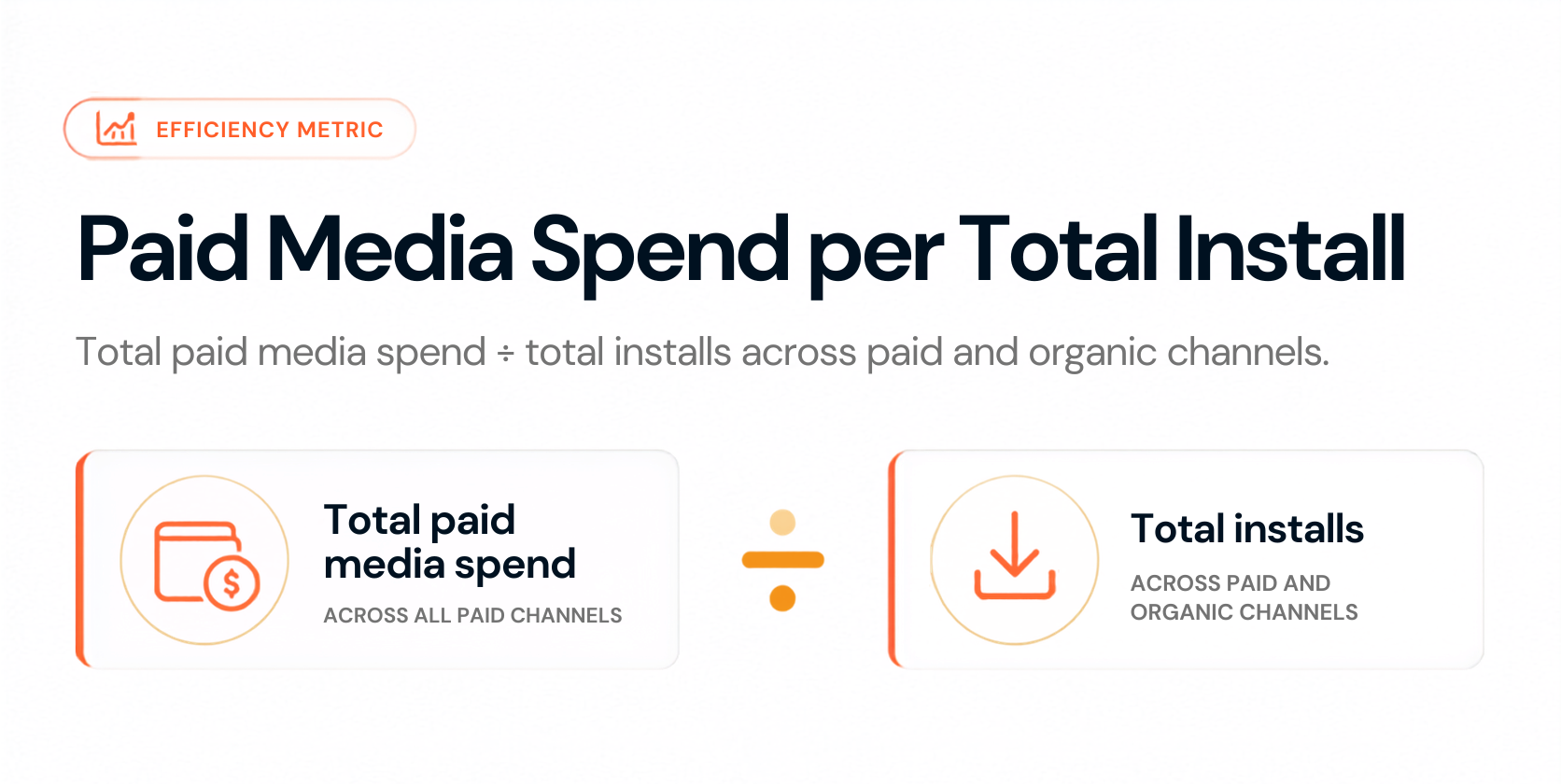
This can provide a useful view of how paid investment relates to overall acquisition volume. However, it should be treated as an efficiency datapoint rather than a complete measure of acquisition cost, as it does not account for other investment such as ASO agency or internal resource, creative production or wider marketing activity.
Similarly, a blended cost per registration, subscription, purchase or other meaningful event can provide a broader view of acquisition efficiency across the programme. These metrics can help account for the wider impact of paid activity and improved store conversion, but should always be considered alongside channel level performance and the total investment required to generate growth.
However, blended measurement should not replace channel level analysis. The goal is to understand both how individual channels are performing and how they are contributing to overall growth.
For ASO, success should extend beyond rankings alone. An app can rank well for a keyword and still have a poor store conversion rate. Equally, an improvement in screenshots may significantly increase conversion without dramatically changing keyword rankings. The most useful measurement framework looks at visibility, acquisition, conversion and downstream user quality together.
Best practices for combining organic and paid acquisition
Building a successful mobile acquisition strategy requires continuous collaboration across both disciplines. Some key best practices include:
- Optimise your App Store listing before aggressively scaling paid campaigns.
- Continuously test metadata, screenshots, messaging and tailored product pages.
- Use ASO experiments to identify messaging and creative insights that can inform paid campaigns.
- Use paid creative, audience and search insights to improve ASO and organic activity.
- Test review prompts and encourage ratings and reviews at appropriate moments in the user journey.
- Align CRM and lifecycle activity with paid acquisition campaigns.
- Optimise paid activity towards meaningful in app events rather than installs alone.
- Regularly refresh both paid and organic creative using data led insights.
- Monitor visibility across search, browse and recommendation surfaces.
- Measure both channel level performance and blended acquisition efficiency.
- Treat ASO as an ongoing optimisation process rather than a one off project.
When paid acquisition and ASO work together, the result is a more efficient and scalable growth engine.
Conclusion
In 2026, successful mobile user acquisition is no longer about choosing between paid and organic growth. It is about understanding how the two can work together to create a more effective and sustainable acquisition strategy. Paid acquisition provides speed, scale and valuable performance insights, while organic activity builds long term visibility and creates additional opportunities for discovery.
ASO sits at the intersection of the two, helping apps capture demand, improve store conversion and turn both paid and organic visibility into valuable users. When paid creative, ASO, Custom Product Pages, organic discovery and downstream performance data are connected, each discipline can strengthen the others. The result is a more unified acquisition strategy that can improve efficiency, attract higher quality users and create stronger foundations for sustainable long term growth.
To discover more, or to chat to our team about your approach to User Acquisition, get in touch.










5 minute read
A history of app marketing, as told by a founder who was there before day one
Mick Rigby