

Paid media can be one of the most effective ways to drive growth, though it can also become one of the fastest ways to waste budget. And there lies the question: how much should you spend on user acquisition?
The right amount of spend to attribute to your user acquisition efforts depends on your app’s growth stage, measurement setup, retention performance, monetisation model and creative testing capacity. There is no universal budget that works for every app.
For app teams, the real question is not simply, “Should we spend money on user acquisition?” It is, “Are we ready to spend in a way that creates measurable, sustainable growth?”
Paid user acquisition, often shortened to paid UA, should never be treated as a quick fix for slow downloads. Used too early, it can amplify weak retention, unclear positioning, and poor onboarding, but if used strategically, it can validate growth opportunities, generate valuable data, and enable your app to scale with confidence.
Which problem are you trying to solve?
Before launching ads or spending budget, define the role paid user acquisition plays in your growth strategy.
Are you trying to:
- Validate demand for a new app?
- Accelerate growth after early traction?
- Reach a new audience segment?
- Improve visibility in a competitive category?
- Support a launch, feature release or seasonal campaign?
- Compensate for weak organic performance?
Paid user acquisition works best when it is attached to a clear growth objective. It tends to underperform when used reactively, especially if the real issue lies elsewhere in the funnel.
For example, paid media cannot fix a confusing onboarding journey, or compensate for weak product-market fit. Paid media is unlikely to drive long-term retention if users do not experience value early enough.
What paid media can do is create visibility, generate behavioural data and drive qualified users into a funnel that is already built to convert.
How much should you spend on user acquisition?
A sensible starting budget is best guided by the amount of data you need to make a decision. If your budget is too small, you may not generate enough installs, events or conversions to gain useful learnings. If your budget is too large, you risk scaling before you have a clear sense of what is working in your favour.
Early user acquisition spend is most effective when it is designed to answer questions such as:
- Which audiences respond to your app?
- Which messages drive stronger intent?
- Which creative formats generate quality users?
- Which channels produce better activation and retention?
- Which campaigns are worth scaling?
At the testing stage, aim to budget enough spend to generate meaningful evidence without scaling uncertainty.
Link your budget to your expected cost per install, conversion rate and the number of users or events you need to evaluate performance.
For example, if your cost per install is high and your key conversion event happens several steps after install, you will need more budget to generate a reliable signal. If your category has lower install costs and users convert quickly, you may be able to gauge learnings with a smaller initial test.
When is your app ready for paid user acquisition?
Spending too early is one of the most common pitfalls in app growth. If your app has weak retention, an indistinct onboarding journey, or limited tracking, paid user acquisition is unlikely to solve the underlying issue. In many cases, it may simply bring those issues to the surface sooner.
A campaign that delivers thousands of low-cost installs, but no activation, engagement or revenue can be misleading. Focus your efforts on acquiring users who take meaningful actions, rather than driving downloads from users who do not return.
Start small, but stay focused
Early paid user acquisition is most useful when it centres around learning, rather than scale. This stage is about testing which messages resonate, which creative formats drive action, which audiences value, and which channels warrant deeper investment.
In the early stages, look out for key indicators such as:
- Which ad concepts drive the strongest click-through rate?
- Which audiences activate after install?
- Which channels produce higher retention?
- Which messages align with monetisation?
- Which creative formats generate repeatable performance?
If your early campaigns are not producing useful insight, the issue may not be the size of your budget. More often than not, it comes down to the structure of the test, the clarity of the hypothesis, and whether the campaign has been set up to measure the right user behaviours. For example, a strong test might be built around the hypothesis: “We believe creator-led video will drive stronger activation than static product-led ads for this audience segment.” This gives you something specific to measure, compare, and act on, and will prevent performance from being left open to unclear interpretation.
Paid user acquisition is best placed to operate as an experimentation engine first, with scale coming later once the signals are strong enough to justify further investment.
Choosing the right paid user acquisition channels
Different paid channels, such as Meta, TikTok, and Google, serve different strategic purposes. It can be more useful to consider the role each channel plays and how it supports your wider growth strategy.
Google Ads
Google Ads perform the best when user intent already exists.
If someone searches for “best budgeting app” or “learn Spanish fast”, they already understand the problem they want to solve. Google allows you to capture that demand at the point of search.
This can make Google Ads a highly effective channel for categories where users are already looking for a solution. However, it can be limited by demand volume. If people are not actively searching for your category, Google cannot create that demand on its own.
Meta
Meta, including Facebook and Instagram, is built for scalable audience expansion.
It relies less on direct search intent and more on audience modelling, creative testing and conversion signals. Meta can be powerful once you understand which audiences convert and your event tracking provides the algorithm with enough meaningful data.
However, Meta performance depends heavily on creative. Be sure to refresh concepts, test new angles and learn from performance data, to prevent results from plateauing quickly.
TikTok
TikTok often performs particularly well in upper-funnel activity, especially when the goal is broad awareness or early-stage audience engagement. It can introduce your app to users before they are actively searching for a solution. This makes it especially relevant for lifestyle, entertainment, health, education and visually engaging app categories.
However, TikTok requires platform-native creative. Overly polished ads often underperform compared with content that feels authentic, fast-paced and creator-led.
The channel to focus on depends on your app category, audience behaviour, budget, creative capability and growth objective. Strategise as a priority, rather than basing your activity on where your competitors are spending, or current platform trends.
Which metrics actually prove return on investment?
Cost per install is often treated as the headline metric in paid user acquisition.
However, it is not always the most meaningful indicator of performance. A low cost per install may appear efficient on the surface, but if those users do not activate, engage, or monetise, the campaign is not delivering value.
A more useful measurement framework looks across the full user journey.
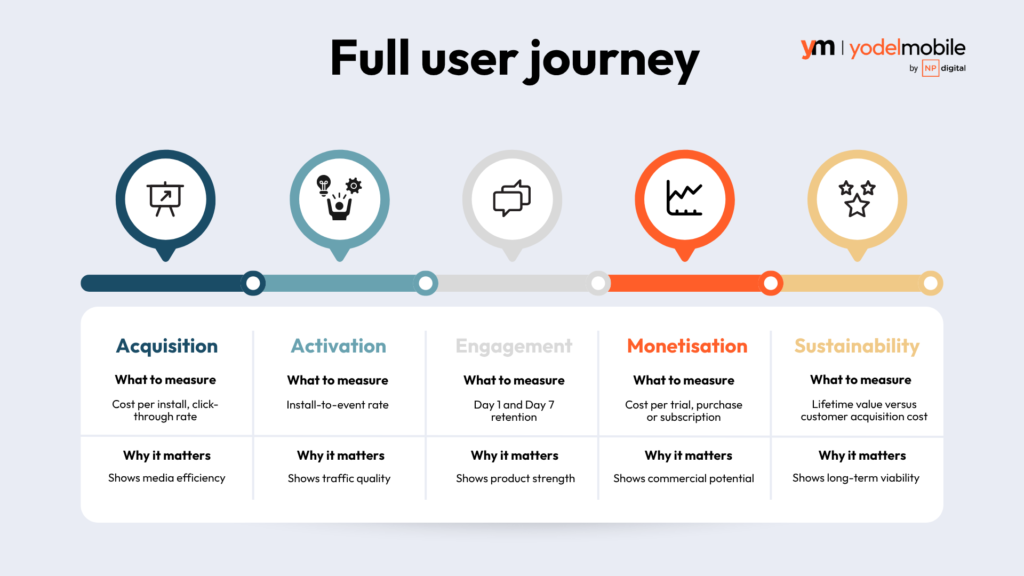
Rather than focusing solely on acquiring the lowest-cost users, it is often more valuable to consider the long-term contribution those users may make. That means your paid user acquisition strategy is best optimised around meaningful actions, such as account creation, first purchase, subscription trial, completed booking, content creation or repeat usage.
The exact event will depend on your app, but the principle remains the same: optimise for behaviours that indicate real value, rather than vanity metrics which may appear strong on the surface but fail to support long-term growth.
When should you scale, pause or reset?
Paid user acquisition is rarely linear, and often requires ongoing evaluation across performance, product behaviour, and market conditions. Consider scaling when retention is consistent, cost per install is stable, activation rates are strong, monetisation signals are improving, creative testing continues to produce winners, and customer acquisition cost sits within an acceptable range.
From this point, scaling spend becomes more efficient because it is driven by proven signals rather than assumptions. Consider pausing or resetting paid activity when costs rise without revenue improvement, retention weakens, creative fatigue sets in, audience saturation limits efficiency, product updates change your positioning, or campaigns stop producing useful learning.
Paid user acquisition should evolve with your product, audience and market, especially if your app introduces a new feature, changes its onboarding flow or shifts its value proposition, as the same creative, audience and messaging may no longer reflect what the app offers.
Static campaigns rarely remain efficient for long, so your approach to scaling, pausing, or resetting is best based on what your data shows you and how your app is changing.
What happens if you do not invest in paid user acquisition?
A strong organic foundation is key to your app marketing growth mix. However, relying solely on organic growth will mean you are extremely dependent on algorithm changes, category competition, search trends and external visibility.
Meanwhile, competitors investing in paid user acquisition can capture additional demand, test faster, and build stronger market presence, making paid activity both an offensive and defensive lever in competitive categories.
Paid user acquisition helps you reach new users and also compete for visibility against competitors who are also spending.
So, do you really need to spend on user acquisition?
If your goal is predictable, scalable app growth, paid user acquisition will likely need to play a role, but only when your app is primed and ready to turn spend into meaningful user behaviour.
Paid user acquisition is often most effective when it is tied to measurable post-install outcomes, supported by clear audience insight, effective onboarding, reliable retention signals, and defined in-app events, rather than in a siloed attempt to speed up downloads. Used too early, paid user acquisition amplifies weaknesses, but used strategically, it compounds strengths and helps turn spend into sustainable growth.
If you are unsure whether your app is ready for paid user acquisition or if you need to improve the efficiency of your existing campaigns, get in touch with our team.