
Last week, we explored the changing landscape of app marketing and how Megan Dean, Strategic Growth Director at Yodel Mobile, is defining this next phase as ASO 3.0.
While AI-driven discovery is growing rapidly, it is not replacing the role of the app stores. Interest is high, but usage is not yet dominant, and users still place greater trust in the App Store and Google Play than in AI tools when making download decisions.
How can you build ASO 3.0 into your mobile growth strategy?
Marketers should respond to this shift without becoming distracted by it. Rather than focusing on AI discoverability in a silo, focus on creating content which addresses the E-E-A-T (Experience, Expertise, Authoritativeness and Trustworthiness) framework for an improved likelihood of visibility.
Brands are also best placed to focus on strengthening the assets, signals and structures that improve discoverability across the wider growth engine, including AI assistants, paid acquisition, app store search, custom store experiences, conversion optimisation and product credibility.
The winners in ASO 3.0 will not be the brands that react fastest to hype, but the ones that build the clearest, most connected and most commercially effective discovery systems.
Build intent clusters around real user problems
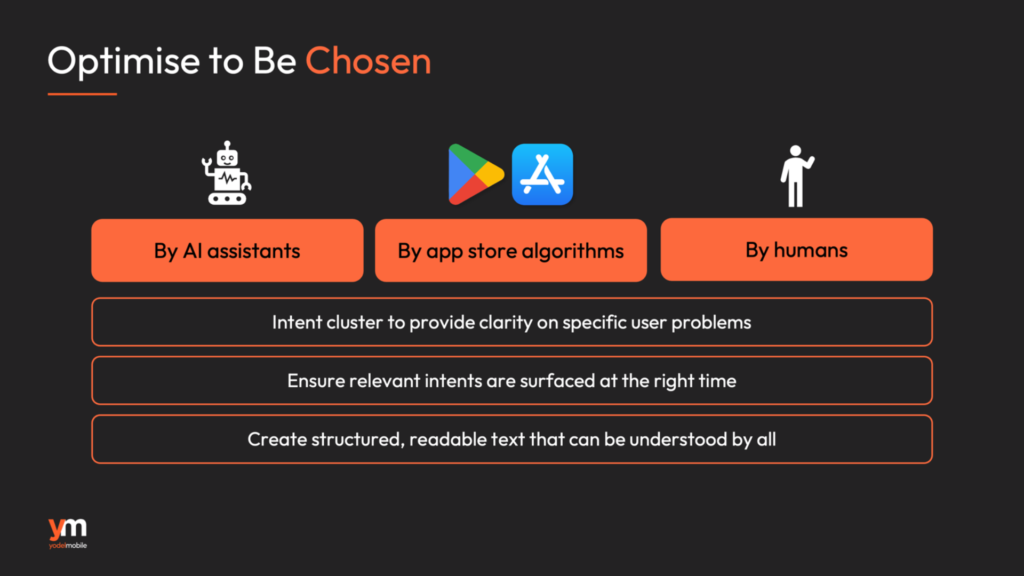
Intent can no longer be treated as a light-touch keyword variation exercise. Angle your mobile growth strategy to reflect the situations, motivations and expectations behind a user’s search.
For a language learning app, that means thinking beyond terms like “learn Spanish” or “learn French”, because users may be learning for travel, work, relocation, certification or conversation confidence. They may also care about speed, flexibility, offline access, hands-free learning or speaking practice.
This will help to differentiate between generic visibility and relevant visibility. Brands that map these needs properly can create messaging that better aligns with how users search, how AI interprets prompts and how the app stores understand contextual relevance.
Match intent with tailored app store experiences
Once intent is mapped, the next step is to surface the right message at the right point of conversion. This is where Custom Product Pages and Custom Store Listings become more valuable, not only as conversion tools but as ways to make app relevance more explicit.
Too many brands still rely on a single default listing to do everything, but that approach is becoming increasingly inefficient. If users have different needs, the store experience should reflect that. More specific landing experiences can improve conversion through more relevant messaging, while also strengthening the contextual signals available to the app stores over time.
Make your text easier for machines to interpret and humans to trust
Megan also made the case for more structured, more deliberate app store text, which is especially important as AI systems increasingly rely on content that is easy to parse, quote and validate.
On Google Play, this means using the long description more strategically and understanding how Google classifies the language used. On iOS, where the long description has traditionally been treated as lower priority for App Store Optimisation, its value is changing. Even if it does not directly influence keyword indexing, it can still help shape how AI systems understand and reference the app.
This makes clarity a performance consideration, not just a copywriting principle. App store text needs factual grounding, strong semantic coverage, readable structure, clear intent signals and credible proof points. Anything vague, overwritten or unsubstantiated fast becomes a weakness.
Connect AI optimisation back to commercial outcomes
One of the most valuable takeaways from Megan’s session was that AI-readiness only becomes meaningful when it is measured properly and tied back to the wider commercial outcomes of your mobile growth strategy.
At Yodel Mobile, we help leading brands to evaluate whether app store content is structured to improve interpretability, credibility and citation potential. The objective is not to chase mentions for vanity, but to drive meaningful traffic, stronger visibility and more valuable installs.
This distinction matters because AI optimisation is only useful when it improves commercial outcomes. Do you need help connecting AI with your app optimisation strategy? Then get in contact with our team who can help you with an audit.