
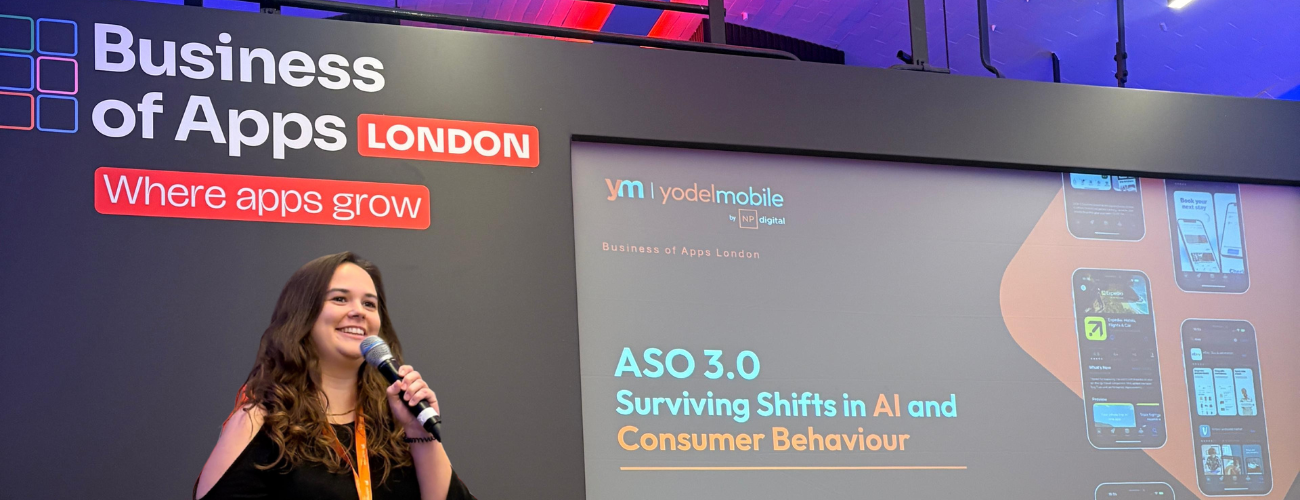

We attended Business of Apps London 2026, where leaders from across the app marketing ecosystem came together to share practical insights, emerging strategies and real-world case studies.
Across multiple stages, sessions covered the full growth funnel, from user acquisition and ASO through to engagement, retention and monetisation. Unsurprisingly, AI was a consistent theme throughout the day, with many speakers exploring how it is reshaping discovery, decision-making and optimisation.
In this roundup, we’ve pulled together a selection of standout sessions and key takeaways, ideas that challenged conventional thinking, sparked new approaches and offer practical direction for the months ahead.
The AA: building a digital motoring companion beyond breakdowns
In a standout session, David Thompson, Head of Mobile & Engagement, and Anna Sarrou, Head of User Research, shared how The AA transformed its mobile app from a breakdown-led utility into a broader digital motoring companion.
While the AA has extremely high brand recognition, with over 80% awareness, breakdowns happen infrequently for most drivers. That meant many customers only had a reason to engage with the brand in a moment of need, making it harder to build regular app usage and strengthen the customer relationship throughout the year.
To address this, the team followed a double diamond approach, using existing user research, market insight, persona work, competitor analysis and proposition testing to understand where the AA could solve genuine customer pain points beyond breakdown cover. This included looking at key moments across the driving lifecycle, from learning to drive and buying a car, to managing vehicle costs and maintenance.
From this work, the team landed on a clear strategic ambition: to make the app a digital motoring companion that gives customers confidence across all their driving needs.
The business case centred on a simple but powerful hypothesis: if the AA could increase regular engagement through its app and digital services, it could improve retention. To prove this, the team identified key lead indicators, including user growth, frequency of use, breadth of feature usage and App Store ratings.
The redesigned app focused on improving the customer experience, modernising the technology and making everyday driving features more accessible. Two features stood out in the session. Fuel Finder helps users compare local fuel prices, creating a softer and more regular reason to open the app. Car Valuation, delivered through a partnership with Motorway, gives customers visibility of one of their most valuable assets and opens up further opportunities around selling, buying and financial services.
The impact has been significant. The AA now has 6.2 million digital users across app and web; app frequency is up 10% year on year, feature usage is up 23% year on year, and its App Store rating has increased from 4.7 to 4.8.
The key takeaway was that app engagement is not built by launching features in isolation. It requires a clear understanding of customer needs, a strong business case, continuous investment and smart activation across the wider customer journey. As the speakers put it, it is not simply a case of “build it, and they will come”; brands need to create genuinely useful app experiences, then give customers relevant reasons to discover and return to them.
ASO 3.0: Optimising for AI, app stores and human intent
In a packed-out session at Business of Apps London 2026, Megan Dean, Strategic Growth Director at Yodel Mobile, explored the next evolution of App Store Optimisation, what she described as ASO 3.0. Building on the shift from traditional keyword-led ASO to a more full-funnel discipline, Megan explained how AI is now changing how users discover, evaluate and choose apps.
“AI assistants don’t just introduce a new discovery channel; they compress the decision funnel,” Megan explained. Where users would once move through consideration and evaluation themselves, tools like ChatGPT, Gemini and Claude are increasingly helping to compare options, interpret needs and recommend products. For app marketers, this means the challenge is no longer just being found, it is being understood, trusted and chosen.
During the session, Megan explored how AI translates subjective user needs into product features. A search like “best fitness apps for people who get bored easily” is no longer just a keyword query; it signals intent around variety, motivation, gamification, friction and engagement style. This makes semantic relevance and intent coverage increasingly important, both for AI assistants and for app store algorithms.
Drawing on Yodel Mobile’s recent research of 4,000 consumers across the UK and US, Megan highlighted that users still place huge importance on clarity, relevance and social proof. 89% said they need a clear explanation of what an app does, 88% said the app needs to show it solves an immediate problem, and 83% consider ratings and reviews important. These same signals are increasingly important for machines too, with AI tools looking for structured, readable content, factual grounding and clear evidence of relevance.
However, Megan was clear that AI is not replacing traditional app discovery just yet. While 72% of respondents have used AI assistants to discover new apps, only 10% typically use AI for app discovery, compared with 29% who use the app stores. “AI becomes another cog in the growth engine,” Megan noted, rather than a replacement for existing discovery journeys.
The app stores themselves are also becoming more AI-led. Megan pointed to Google Play’s guided search, AI review summaries, and Ask Play functionality, alongside Apple’s natural language search, app tags and review summaries. With the stores able to access deeper quality signals, from conversion and retention to crash rates and purchase behaviour, they may be better placed than external LLMs to deliver relevant recommendations.
To succeed in this new ecosystem, Megan argued that brands need to optimise to be chosen across three audiences: AI assistants, app store algorithms and human users. This starts with intent clustering, understanding the different functional, situational and motivational contexts behind a search. For example, a language learning app might need to demonstrate relevance for users learning French, learning on the go, preparing for travel, studying for an exam or trying to become conversational in 30 days.
Megan also highlighted the importance of surfacing these intents at the right time, using Custom Product Pages on iOS and Custom Store Listings on Google Play to create more tailored, relevant store experiences. Finally, she emphasised the need for structured, machine-readable text, particularly as AI assistants increasingly cite app store listing content when answering app-related queries.
Her closing message was clear: ASO 3.0 is not about abandoning the fundamentals; it is about evolving them. Clarity, relevance and credibility remain critical, but the way they are interpreted is changing. Apps now need to be understandable to humans, legible to algorithms and credible enough to be recommended by AI.
The latest trends in the influencer marketing circle
Tatam Digital brought together a strong panel of app marketers to explore what’s next in influencer marketing. Lucia Aguilar, CEO of Tatam Digital, was joined on-stage by Joanna Malecka, Partnerships Director at Numan, Esma Ebnu, Influencer Marketer at Flo Health, Lia Darozhkina, Senior Influencer Marketing Manager at Trade Public, and Stephanie Terziyski, Growth Influencer Marketing Manager at Hello Fresh, as they delved into the latest trends sweeping the influencer marketing.
A key theme from the ‘Influencer Marketing Circle’ session was the rise of YouTube advertorial content. YouTube was denoted as the number one TV network by ad revenue in 2025, surpassing Netflix and accounting for 13% of all viewing time in the US. In 2025 alone, YouTube’s ad revenue reached an astonishing $40.8 billion, exceeding the combined $37.8 billion from Disney, Paramount, Universal and Warner Discovery TV Networks.
This growth is being accelerated by the increase in YouTube shorts, which are favoured by Google search, and the shift towards connected TV (CTV) as a primary viewing device, reinforcing the premium being placed on creator-led content.
For brands, YouTube offers something other platforms often cannot: long-form storytelling, product education, and evergreen content that can keep driving results for years. This makes it especially strong for subscription, finance, health, and consideration-purchase products.
Another major market shift highlighted in the session was the rise of creator-led paid media. Brands are seeing stronger performance from ads run through creator accounts than from traditional brand ads (4x CTR and 2x CPC for some of Tatam Digital’s clients) as the content feels more native and trusted. Many marketers now combine larger influencers for awareness and trust with UGC creators for testing and lower-cost conversion.
The industry is also becoming more regulated, following the introduction of the Advertising Standards Authority’s AI-powered Active Ad Monitoring system. Disclosure rules around ads, gifting, and endorsements are tightening, particularly in sectors like healthcare and finance. Compliance now needs to be built into campaigns from the start.
Finally, AI is improving operations through creator sourcing, reporting, forecasting, and content monitoring. However, while AI can boost efficiency, authentic human creators remain the real driver of trust and performance.
Beyond the post: creators as community managers and retention drivers
Freya Fine, founder of growth marketing agency &Fine, led a standout roundtable on how creators are becoming far more than content producers – they are now key drivers of app growth, community building, and retention.
A major theme was that creator accounts often outperform traditional brand accounts in paid social because audiences trust people more than polished corporate content. Freya also stressed that follower counts and likes can be misleading; stronger indicators of creator quality are saves, shares, comments, and genuine audience interaction.
Freya highlighted the difference between reach and saleability: large creators may have visibility, but smaller, highly engaged creators often drive stronger downloads and conversions because their recommendations feel more authentic.
Freya described UGC creators as modern community managers, using comments, replies, and direct messages to build trust and encourage installs. She also noted that retention increases when creators repeatedly share their real app usage through stories or short-form updates, showing ongoing value rather than a one-off promotion.
The roundtable concluded that in a market flooded with AI-generated content, real people and credible recommendations are becoming more valuable than ever.
Final thoughts
BOA London brought together the best in the business this year to share how the app space is evolving. While last year was all about privacy and how to get around it, this year really highlighted how to use and adapt to AI.
Whether you’re refining your AI strategy or exploring new ways to break into acquisition channels, come discuss it with us by getting in touch with us today.





5 minute read
Viewpoint – The great flattening: How algorithmic marketing is erasing brand identity
Yodel Mobile