

Yodel Mobile has been in the app space for over 18 years now – and there’s one common scenario we see time and time again. A web-first business invests a huge amount of money developing an app, because “everyone else has one!” – but when it comes to post-launch support, huge amounts of profit are left on the table.
The “build it, and they will come” mentality leads app owners to under-invest in their app marketing efforts or invest in the wrong places. It can be difficult to incorporate this new platform, which appears to operate similarly to the web but also not at all, into your overall business plan in an effective, ROI-positive way. So, the app falls off the plan and sits untended like the black sheep of the family.
Make the business case
So, why should you make app more of a priority across your business? We want to reach users where they spend their time – So, why should you make the app more of a priority across your business? We want to reach users where they spend their time. In 2025, UK adults spent an average of 4 hours 30 minutes online per day, with most of that time spent on smartphones. Apps tend to be much higher value than mobile web, too – on average, users convert to purchase at a 157% higher conversion rate on apps than on mobile web.
The opportunity is there; we just have to know how to use it. While app stores are increasingly focusing on releasing features that give app owners more capability to customise the user journey, the traditional web landscape is being transformed by AI Overviews and a diversification of user discovery methods. In terms of how people search for questions online, search engines have dropped from being the go-to source 98% of the time in 2020, to 61% in 2024 – the gap being filled by social media and AI chatbots.
Pulling together the capabilities available to app owners can unlock significant revenue, enabling the app to become a key arm of the overall business.
Setting foundations with KPI alignment
To truly make the most of the app, there must be prioritisation alignment across all teams – whether that be growth, marketing or product. Define your success metrics, starting with a “North Star”, which is your biggest indicator of business success. For example, a subscription app may use metrics such as Monthly Recurring Revenue, Number of Premium Subscribers, or Cost per Acquisition as its North Star.
From there, break this metric down into another layer of KPIs – which key metrics which will impact the North star the most? For number of premium subscribers, you might consider metrics such as volume of installs and the conversion rate from install to subscription. Break each of these sub-metrics down into one more layer, and you’ll have a three-step metric hierarchy that will be key to achieving business success.
While the North star is most relevant at the business level and should be determined in line with broader business goals, the sub-metrics are more actionable and can be impacted across all teams. This will help the teams align and prioritise their resources and investments by identifying which metrics have room for improvement.
It’s important to be realistic about where opportunities lie – these KPIs should be benchmarked against the industry, where possible, to understand what you could expect to achieve. There are a lot of great benchmarking tools publicly available, such as Appsflyer’s CPI benchmarks tool, or RevenueCat’s subscription health score.
Planning your marketing activity
Paid user acquisition for apps can be tricky, but there are a few core channels that are a great place to start – we call these the “golden triangle”:
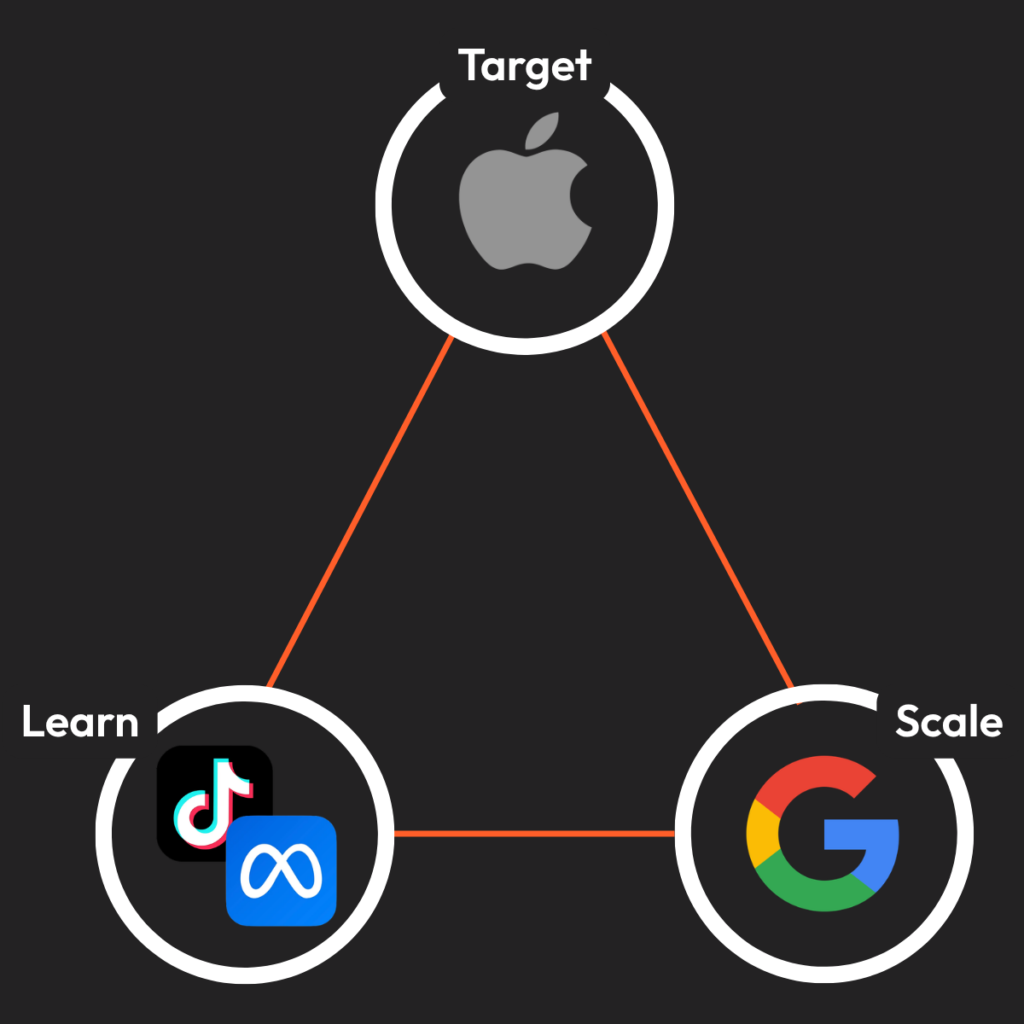
- Apple Ads give you the opportunity to target on a keyword-specific level, allowing you full customisation over what terms you bid on. Users reached by Apple Ads are already searching for something, so the intent and ROI tend to be high.
- Google allows you to scale significantly – with a wide range of placement types and a huge inventory, the algorithm, given enough runway and data, is very good at identifying high-value users.
- Meta & TikTok are highly creative-led channels, offering the opportunity to test many different creatives and learn about your best user types. Rather than trying to define demographics up front, we prefer to cast a broad net and see where traction patterns emerge – at this point, we can create more assets to target this type of person and even launch new, more specific campaigns. With this method, we can focus on the underlying motivators and values that bring your audience together, rather than imposing arbitrary limitations on targeting.
A good spend benchmark for campaigns across these channels is £30-52k per month, allowing enough budget for the algorithms to learn and optimise. This is crucial for campaign evolution – if your campaigns are optimising for installs, we can move this optimisation goal down-funnel (e.g., to registration) once we start to receive 30-50 target events (registrations) per day, per campaign. This will ensure campaigns are constantly becoming more effective at reaching your high-value audience.
Supporting paid activity
A key facet of app marketing is that all acquisitions must pass through the app stores. This, alongside the broadening discovery behaviours of users mentioned earlier, means that App Store Optimisation (ASO) is a core requirement for any app marketing activity.
Consider techniques such as custom landing pages for user acquisition to improve conversion to installs and overall ROI, and ensure metadata is optimised for broader keyword searches that may be relevant to your app. A strong organic-to-paid install ratio will offset marketing costs and drive you towards ROI-positive activity.
Alongside this pre-install activity, product optimisation should be conducted in collaboration with the marketing and growth teams. Incremental gains across the user funnel can make a huge difference to overall performance, so product teams should look to take learnings on audiences, creative and value propositions from UA & ASO and use these to iterate the product and drive improvements to those KPI hierarchies post-install.
Conclusion
The users you’re trying to reach are spending their time in apps – so make sure that you’re one of them. When determining how to incorporate app marketing into your business plan, consider the following:
- Align goals and KPIs across all departments to ensure prioritisation is clear.
- Invest marketing budget wisely and ensure you gather as many learnings as possible from the activity you run.
- Support paid campaigns with optimisation on the app stores, whether this be through conversion activity or improving the discoverability for organic users.
- Ensure products learn from marketing and iterate to consistently improve the user funnel.
If you want to learn more from the best in the business about drafting an app marketing business plan to see actual growth, then make sure to contact our team here.